+ TRIDUUM +

Initium sancti EvangélII secúndum Joánnem...

In principio erat Verbum et Verbum erat apud Deum et Deus erat Verbum 2 hoc erat in principio apud Deum 3 omnia per ipsum facta sunt et sine ipso factum est nihil quod factum est 4 in ipso vita erat et vita erat lux hominum 5 et lux in tenebris lucet et tenebrae eam non conprehenderunt

6 fuit homo missus a Deo cui nomen erat Iohannes 7 hic venit in testimonium ut testimonium perhiberet de lumine ut omnes crederent per illum 8 non erat ille lux sed ut testimonium perhiberet de lumine 9 erat lux vera quae inluminat omnem hominem venientem in mundum 10 in mundo erat et mundus per ipsum factus est et mundus eum non cognovit

11 in propria venit et sui eum non receperunt 12 quotquot autem receperunt eum dedit eis potestatem filios Dei fieri his qui credunt in nomine eius 13 qui non ex sanguinibus neque ex voluntate carnis neque ex voluntate viri sed ex Deo nati sunt 14 ET VERBUM CARO FACTUM EST et habitavit in nobis et vidimus gloriam eius gloriam quasi unigeniti a Patre plenum gratiae et veritatis

+ Prayer Requests and Intentions + Updated 5 Nov.

+ Blessed Mother Mary Ever-Virgin; Holy Archangels Michael, Gabriel, and Rafael; the communion of all Saints, and all holy men and women: pray for us... +

-For our Holy Father, H.H. Pope Benedict XVI
-For our Bishops and Priests, and all religious
-For our Holy Mother Church, the Bride of Christ, for Her defense from the Enemy
-For an end to all abortions and for a renewed culture of life
-For an increase in vocations, particularly to the Holy Priesthood
-For all our prayers, hear us.

-For all the faithful departed, especially Ramon and Willie, my grandfathers. Requiescant in pace.

Coming Soon...

Stay tuned.

23 July 2009

"Caritas in Veritate: But is Christ Still King?" - borrowed from The Remnant Newspaper

This is a fascinating article on the hermeneutics of continuity and the Church's teaching on the social kingship of Christ...
~~~~

"Caritas in Veritate: But is Christ Still King?" - by Christopher A. Ferrara, The Remnant Newspaper
http://www.remnantnewspaper.com/Archives/2009-0715-ferrara-caritas_in_veritate.htm

(Posted 07/22/09 www.RemnantNewspaper.com) In Caritas in Veritate, his long-awaited encyclical on Catholic social doctrine, Pope Benedict XVI insists that “It is not a case of two typologies of social doctrine, one pre-conciliar and one post-conciliar, differing from one another: on the contrary, there is a single teaching, consistent and at the same time ever new.” Caritas, n. 12.

The Pope’s application of his own “hermeneutic of continuity” to the Church’s social doctrine prompts a recollection of Church teaching on what Pope Pius XI, in Ubi Arcano Dei (1922), called “the social rights of Jesus Christ, Who is the Creator, Redeemer, and Lord not only of individuals but of nations.”

Recalling the Social Kingship Doctrine

Before the Second Vatican Council, the Social Kingship of Christ had been the paradigm of the Church’s social doctrine for centuries, especially evident in the long line of anti-liberal encyclicals issued by Pius VI, Pius VII, Pius VIII, Gregory XVI, Blessed Pius IX, Leo XIII, Saint Pius X, and Pius XI.

But then came Dignitatis Humanae (DH), whose “on the one hand/on the other hand” ambiguity concerning “religious liberty” in contemporary political circumstances has produced endless contention over whether the Social Kingship doctrine “remain[s] still in full force,” as Pius XI insisted a mere 40 years before the Council, condemning the “moral, legal, and social modernism” of Catholics who suggested otherwise. Ubi Arcano, nn. 60-61.

Tellingly, DH itself begins by declaring that it “leaves untouched traditional Catholic doctrine on the moral duty of men and societies toward the true religion and toward the one Church of Christ”—that is, the duty of men and nations to profess the true religion and submit to the authority of the Catholic Church. This duty is the Social Kingship in its essence. DH had to leave this doctrine “untouched” because it is not some piously “triumphal” sentiment of a bygone era, nor even a matter of faith alone, but rather a dictate of reason informed by faith.

Respect for the rules of thought without which reason is impossible requires that he who says A must also say B, if B follows logically from A. To accept the premise while rejecting the conclusion is simply to refuse to think. Thus, if one accepts the premise that Christ is God Incarnate then it follows—as B follows from A—that the Church He established is “the kingdom of Christ on earth, destined to be spread among all men and all nations.” So Pius XI declared only 37 years before Vatican II in Quas Primas (1925), echoing the words of the divine Founder Himself. Cf. Matt. 28:19-20.

Nor can it be argued logically that an omnipotent and infallible God would found a Church of unknown identity, or that it would lose its identity, divide into parts, or fall into error. The Church that God founded would have to be—and would declare itself to beindefectible and infallible concerning what she actually imposes as binding in matters of faith and morals. Only one Church in human history answers to that description.

Moreover, if Christ is God then it follows—as B follows from A—that His kingdom cannot be limited by geography or the boundaries of human polities. Hence the kingdom includes, as Pius XI insisted, “not only Catholic nations, not only baptized persons who, though of right belonging to the Church, have been led astray by error, or have been cut off from her by schism, but also all those who are outside the Christian faith; so that truly the whole of mankind is subject to the power of Jesus Christ.” Cf. Quas Primas, n. 18.

Nor, said Pius, “is there any difference in this matter between the individual and the family or the State; for all men, whether collectively or individually, are under the dominion of Christ. In him is the salvation of the individual, in him is the salvation of society.” Ibid.

In Him is the salvation of society. This is the doctrine of the Social Kingship in a single phrase. From which it follows—as B follows from A—that in the Church of Christ are the means by which not only men but societies are to be saved: the sacraments as channels of His personally and socially transformative grace; the Magisterium as the infallible preceptor of individuals and communities; and a hierarchy to govern a kingdom embracing all nations. For if Christ had failed to provide these means in His Church then He would not be God, but just another false prophet who left error and confusion in his wake.

From all of this three other conclusions follow as B follows from A, and all three were set forth by Pius XI in Quas Primas:

- First, thatthe Church is by divine institution the sole depository and interpreter of the ideals and teachings of Christ….”

- Second, that “she alone possesses in any complete and true sense the power effectively to combat that materialistic philosophy which has already done and, still threatens, such tremendous harm to the home and to the state,” and

- Third, that “No merely human institution of today can be as successful in devising a set of international laws which will be in harmony with world conditions as the Middle Ages were in the possession of that true League of Nations, Christianity,” but rather “the Church alone is adapted to do this great work” because she is “divinely commissioned to lead mankind” and thus “cannot but succeed in such a venture where others assuredly will fail.”

A corollary conclusion—following as B follows from A—is that if men and nations reject the Social Kingship as exercised through the Church, the world will see all of the social, moral and economic problems Pope Benedict now seeks to address in Caritas. Pius XI lamented the resulting civilizational crisis:

The empire of Christ over all nations was rejected. The right which the Church has from Christ himself, to teach mankind, to make laws, to govern peoples in all that pertains to their eternal salvation, that right was denied. Then gradually the religion of Christ came to be likened to false religions and to be placed ignominiously on the same level with them...

The rebellion of individuals and states against the authority of Christ has produced deplorable consequences…. bitter enmities and rivalries between nations… that insatiable greed which is so often hidden under a pretense of public spirit and patriotism… a blind and immoderate selfishness, making men seek nothing but their own comfort and advantage… no peace in the home, because men have forgotten or neglect their duty; the unity and stability of the family undermined; society in a word, shaken to its foundations and on the way to ruin. Quas Primas, n. 24.

Whither the Social Kingship?

Where does the doctrine so conspicuously left “untouched” by DH stand today? It remains, of course, untouched, for the Church has no power to repeal her own doctrines, nor (as the First Vatican Council made clear) to reveal “new” doctrine contrary to “old” doctrine. Pope Benedict himself has insisted upon this since his pontificate began.

Yet the promises of Christ do not insure that Churchmen will forthrightly affirm the Church’s teaching on any given doctrine at any given time. So, in the face of “a rebellion of individuals and states against the authority of Christ” that has reached a level not even Pius XI could have imagined, we are indubitably witnessing a timid retreat from the Social Kingship doctrine by the Church’s human element. The situation here is the same as with other “hard sayings” of Catholic doctrine contemporary Churchmen are loathe to mention for fear of the world’s mockery or persecution.

But what of Caritas in Veritate, which treats of the same civilizational crisis for which Pius XI prescribed the Social Kingship doctrine and which, moreover, insists upon the unity of faith and reason which underlies that doctrine? Cf. e.g., Caritas, n. 56-57.

First, it must be said that the encyclical is burdened by jargon the likes of which no previous Pope has ever employed, including “quotas of gratuitousness,” “a deeper critical evaluation of the category of relation,” “new efforts of holistic understanding,” “a new humanistic synthesis,” and “a metaphysical interpretation of the ‘humanum’ in which relationality is an essential element.”

It is hard to believe such distinctly non-Magisterial locutions came from the Pope as opposed to the widely-reported drafting committee that clearly added words, phrases and probably entire paragraphs to the document. The facile objection “Well, the Pope signed it” hardly suffices to address the problems posed by poor draftsmanship, against which the Holy Ghost offers no guarantee. And it must be stressed that we have yet to see the official Latin text, absent which the English text must be viewed as tentative.

As it stands, however, the English text reminds one of an omnibus bill to which numerous congressmen have appended amendments. The encyclical covers everything from the Holy Trinity to microfinance and tourism in a long series of paragraphs which (especially in Chapter 5) combine unrelated subjects or jump from one topic to another without any logical transition.

Second, in the midst of all the verbiage, Caritas nevertheless presents important teaching on faith and morals concerning the sociopolitical effects of Original Sin, the natural law, the moral primacy of duties over “rights” (a long overdue statement), the sanctity of human life at all stages, “the centrality and the integrity of the family founded on marriage between a man and a woman,” happiness as the cultivation of one’s immortal soul, and—in a decisive setback for the propaganda campaign of “traditionalist libertarians”—a reaffirmation of the Church’s staunch opposition to the claim that the market economy is an “autonomous” entity exempt from the Church’s thoroughgoing moral scrutiny at every level.

Nevertheless, it must be said that the Pope’s teaching is weakened by an appeal to “human development,” “holistic development” and “the dignity of the person” as grounds for accepting these truths, with no reference to the eternal law, the divine positive law of Christ (and thus no mention of the radical evil of divorce), the Ten Commandments, or the eternal consequences of Original and personal sin. Original Sin is introduced with the almost apologetic phrase “in faith terms” (par. 37), as if it were slightly embarrassing.

Nor does there appear in the encyclical a clear offer of anything beyond human flourishing in this world as the fruit of “charity in truth,” when in the traditional Christian view “God’s eternity” is the goal that, as Charles Taylor observes in his monumental study A Secular Age, unites “ordinary time” with the “eternal paradigms” of divine revelation, giving humdrum earthly existence the “coherence we find in a melody or a poem,” the poem of Christian life with its liturgical year—a coherence that would be lacking in any attempt at “integral human development” only in “ordinary time” without a consistent theme of eternity and final beatitude. Which is to say nothing of the infinite value of beatitude versus the finite good of earthly “human development,” even if that development involves a certain noble cultivation of the soul. The mysterious post-conciliar boycott of the Four Last Things, admitted by John Paul II himself in Crossing the Threshold of Hope, continues. But what is more important to man’s progress and development than these very things?

Revelation itself is given a humanistic turn: “God reveals man to himself” says Caritas (par. 75), echoing Gaudium et spes. Of course this is true, if rightly understood, but is it not time to admit the utter failure of the Council’s verbal Jiu-Jitsu move in attempting to “flip” contemporary man into turning from his sinful ways by being “more human,” as opposed to simply repenting, being baptized, and receiving the grace of sanctification and justification? Was it not the Pope himself, writing as Father Ratzinger just after the Council, who accused Gaudium et spes of employing “a downright Pelagian terminology”? (Cf. Tracey Rowland, Culture and the Thomist Tradition, pp. 24-25). Might it not be prudent to remind a world on the brink of an apocalypse that “the fear of the Lord is the beginning of wisdom”? (Cf. Psalm 111:10).

Third, Caritas also contains numerous vague prudential prescriptions for economic and sociopolitical problems. Chief among these is the Pope’s astonishing call (in par. 67) for “a true world political authority” with the power to compel nations to obey its decisions on such matters as “manag[ing] the global economy…reviv[ing] economies hit by the crisis… integral and timely disarmament, food security and peace… the protection of the environment and… migration.” There is no use denying that the Pope has called for the establishment of a world government, be it a reformed United Nations (as suggested in the same paragraph) or some newly created body.

A Pope has no divine authority to bind Catholics to a fallible prudential judgment of this sort. Quite the contrary, Catholics have every right respectfully but vigorously to oppose creation of a “true world political authority” on grounds that it would only accelerate an attack on the moral order that has already reached apocalyptic proportions, undermine legitimate sovereignty, and persecute the Church and her members, as we have already seen with the UN and the EU. Moreover, the idea of a world government that would “observe consistently the principles of subsidiarity” (par. 67) seems very nearly a contradiction in terms.

Fourth, and most important for this discussion, candor requires one to admit that the Social Kingship doctrine is nowhere to be found in Caritas. Consider that Pope Pius XI’s first encyclical on the Church’s answer to the civilizational crisis, Ubi Arcano, is subtitled “On the Peace of Christ in the Kingdom of Christ,” whereas Pope Benedict’s encyclical on the same crisis 87 years later is subtitled “On Integral Human Development in Charity and Truth.” The radical change of terminology is as unsettling as it is revealing.

Caritas celebrates the teaching of Paul VI in Populorum Progressio (1967), which clearly reflects the “integral humanism” of Jacques Maritain. As the late great traditionalist writer Hamish Fraser noted during the reign of Pope Paul, “Giovanni Battisti Montini (the future Paul VI)… was so enthused and excited by Maritain that he volunteered to translate [Maritain’s] ‘Integral Humanism’ into Italian… Pope Paul is indeed a disciple of Jacques Maritain. So much so that when one reads a typically Pauline socio-political allocution, one might well be reading Maritain.” (Hamish Fraser, “The Kingship of Christ 1925-1975,” in Approaches n. 47-48 [February 1976]).

Maritain, writing just after the reign of Pius XI and during the reign of Pius XII, appeared to affirm the Social Kingship doctrine in advocating a “new age of Christendom.” But his description of this new Christendom is incoherent: “a ‘secular’ Christian civilization” in which the “Gospel leaven” will “penetrate the secular structures of civil life” while leaving intact a “personalist democracy” of “the pluralist type” in which “men belonging to very different philosophical or religious creeds… cooperate in the common task and for the common welfare of the earthly community” based on “assent to the charter and basic tenets of a society of free men.” (In The Social and Political Philosophy of Jacques Maritain, pp. 138, 189, 367).

Maritain was describing a “new Christendom” that is not corporately Christian but rather a pluralist democracy “leavened” in some vague way by Christian influences. The concept makes about as much sense as a “new square” that will have only three corners. Yet it sounds quite familiar today, when the “Gospel leaven” is failing catastrophically to produce the “new springtime for the Church” that both John XXIII and Paul VI (in their fallible prudential judgment) thought they were inaugurating by “coming to terms” with “the modern world” rather than preaching against it with grave warnings as every single one of their predecessors had done.

But, as Fraser observed at the time, “like Maritain, Pope Paul has the faith of Peter,” so that neither man was “a logical ‘integral humanist.” A logical integral humanist, Fraser explained, “rejects the social kingship of Christ and at least implicitly asserts that Christ’s empire does not include human society, and therefore that Christ is not omnipotent,” which amounts to “an implicit denial of the divinity of Christ, and must eventually lead to the transposition of the Catholic faith into the key of naturalism. Which is precisely what has already been done by the most logical ‘integral humanists’.”

Thus, as Fraser observed in 1975, “Paul is continually at war with himself. That is also why he is continually at loggerheads with the entourage he himself appointed. For though like him they too are enthusiastic ‘integral humanists,’ unlike him they are not similarly inhibited concerning ‘integral humanism’s ultimate implications.”

Hence it not surprising that Maritain ended up writing The Peasant of the Garonne to protest many of the “reforms” undertaken in the name of Vatican II, while Pope Paul “found it necessary to write Mysterium Fidei, the Credo of The People of God, Humanae Vitae, etc.” (Fraser, op. cit.). Both Maritain and the Pope he influenced so greatly wanted it both ways: an “updated” Church that remained nonetheless wholly orthodox. The tug-of-war between infallible Tradition and a fallible prudential accommodation to “the modern world” is the cause of the entire postconciliar crisis.

That tug-of-war is apparent throughout Caritas, which oscillates between “integral human development” as made possible only by divine grace, supernatural charity, Christian fraternity, and the Gospel as “fundamental” and “indispensable”—an indirect affirmation of the Social Kingship—and “integral human development” based on “fundamental values,” “universal values” and “reason open to transcendence,” all of which seem to be presented as available to non-Catholics and even non-believers of “good will.” Cf. Caritas, nn. 55-57.

Nowhere does the encyclical state clearly (although it faintly implies) what Pius XI and his predecessors affirmed explicitly: that only the Catholic Church can bring true peace, justice and charity to the world by uniting mankind in one faith and one baptism under Christ the King; that only Christendom, not any merely human alliance, can save a tottering civilization. From which it follows—as B follows from A—that those who say the restoration of Christendom is impossible are also saying that our civilization is in its death throes.

But, like Paul VI, Benedict XVI is not “a logical integral humanist,” even if Caritas employs integral humanist lingo throughout. One need only read the Pope’s closing exhortation to understand this:

Christians long for the entire human family to call upon God as “Our Father!” In union with the only-begotten Son, may all people learn to pray to the Father and to ask him, in the words that Jesus himself taught us, for the grace to glorify him by living according to his will…. May the Virgin Mary—proclaimed Mater Ecclesiae by Paul VI and honoured by Christians as Speculum Iustitiae and Regina Pacis—protect us and obtain for us, through her heavenly intercession, the strength, hope and joy necessary to continue to dedicate ourselves with generosity to the task of bringing about the “development of the whole man and of all men.”

We are within our rights as members of the laity to state the obvious: Caritas is a Janus-headed document that tries to speak in two different voices in two different directions at once—to the faithful and to an unbelieving world—in an effort to persuade both audiences to make common cause for the salvation of human society (whose imminent self-destruction is barely hinted at lest the audience of unbelievers be offended).

But a radical civilizational crisis requires a radical cure, and the only one that exists is the one that Christ prescribes in the Gospel. Which is why, in rejecting as utopian the very notion of a pan-religious alternative to Christendom, Pope Saint Pius X declared in 1910: “[I]n these times of social and intellectual anarchy… society cannot be set up unless the Church lays the foundations and supervises the work; no, civilization is not something yet to be found, nor is the New City to be built on hazy notions; it has been in existence and still is: it is Christian civilization, it is the Catholic City. It has only to be set up and restored continually against the unremitting attacks of insane dreamers, rebels and miscreants. OMNIA INSTAURARE IN CHRISTO.” Cf. Notre Charge Apostolique.

Is Christ still King of all men and all nations? Reason itself tells us it cannot be otherwise, and nothing in Caritas is to the contrary. The answer to the crisis in the Church and the world lies, however, in what Caritas fails to say about the very doctrine the Fathers of Vatican II were at such pains to declare “untouched.” We will know the crisis is coming to an end when the untouched doctrine of the Social Kingship is proclaimed openly and boldly once again. The way things are going, humanly speaking it does not seem likely that that proclamation will occur before the world suffers the terrible witness of its rebellion against the King.

22 February 2009

Brief Reflections on Love, Courtship, and Marriage

I am biting off more than I can chew with this post so I am in quite familiar territory!

Ever since I ended my last relationship I have been in almost constant reflection about the meaning of love, dating, marriage, and the like. The Lord has truly revealed more things to me than I could possibly encapsulate in this blog, but I would like to touch on just a few.

For years as I have contemplated my vocation, the question has always been "Is the priesthood my calling?" It is a good question. But then, it is only half of the entire vocation question. Not until recently did I ask myself "Is married life my calling?" We may often think that the priesthood is for the very saintly and spiritually developed, and rightly so. However, why should not those called to married life be just as saintly and spiritually developed? Marriage is, in a different respect, a form of sacrificial priesthood as is that of the clergyman. The man and the woman, in total sacrificial love, give themselves to one another for the sake of creating children and furthering their unconditional love for one another, which is blessed by God. Likewise a priest gives himself totally to the Church in order to bear spiritual children and deepen in his own love of our Lord. The path is the same: sanctification and salvation.

The key words with regard to love, which is so lost in our society, are sacrifice and selflessness. While I have always been pained in some degree by the way that women in particular are harmed by frivolous dating relationships and the burdens of filling that God-shaped hole in our hearts, as of late it has become a most piercing pain in my heart. How I pray that women and men alike may grow to respect each other's dignity to the fullest, both in that Christian charity to which we must be witness with everyone, and in that more exclusive love reserved to those discerning marriage through courtship, and of course in marriage, which is the most exclusive of relationships in that it alone is procreative. What a beautiful sacrament!

Because marriage is sanctioned by our Lord as a sacrament and makes us co-creators with God the Father, any courting relationship must be centered on Him through prayer, mutual edification, and, most importantly, true Christian love. The number one priority must be the good of the other with a mind to how effective that relationship will be in the short-term as courtship and long-term with marriage. While there are certainly many beautiful emotions and feelings that could come with being with another who we love and seek to know better, the foundation of the relationship must be a very intelligent, almost objective knowledge that time is worth being consecrated to that person. Yes, that person may make you happy, may be fun to be around, and may even be very attractive, but those are secondary traits. We must ask ourselves questions like: is he/she strong in the Faith or aspiring to a deeper Faith? is he/she responsible and mature? is he/she aware of the profundity of the courtship process and the marriage bond? is he/she compassionate and selfness as opposed to self-seeking? etc. etc. Issues of "physical compatibility" must be avoided like the plague as they gravely cloud our judgment. The rule of thumb is to never do anything that you would be ashamed of recounting to your parents and, more importantly, to our Lord.

Above all, before even engaging in a courting relationship, we must know ourselves intimately, which comes first and foremost by knowing our Lord. Inasmuch as we know of His love for us, His expectations, His commandments, and His life on earth, we will know where we stand. We must most certainly be fully honest with ourselves. There is no reason to rush, but neither must we be complacent or slow to seek the answers we need. Only then, knowing who we are, can we offer ourselves to another fully and fearlessly.

1 Cor: 4-13
Charity is patient, is kind: charity envieth not, dealeth not perversely; is not puffed up; Is not ambitious, seeketh not her own, is not provoked to anger, thinketh no evil;

Rejoiceth not in iniquity, but rejoiceth with the truth; Beareth all things, believeth all things, hopeth all things, endureth all things. Charity never falleth away: whether prophecies shall be made void, or tongues shall cease, or knowledge shall be destroyed. For we know in part, and we prophesy in part. But when that which is perfect is come, that which is in part shall be done away.

When I was a child, I spoke as a child, I understood as a child, I thought as a child. But, when I became a man, I put away the things of a child. We see now through a glass in a dark manner; but then face to face. Now I know in part; but then I shall know even as I am known. And now there remain faith, hope, and charity, these three: but the greatest of these is charity.

02 February 2009

From darkness to light: my pro-life journey

Unto the end, a psalm for David, to bring to remembrance that the Lord saved him.
O God, come to my assistance; O Lord, make haste to help me.
Let them be confounded and ashamed that seek my soul:
Let them be turned backward, and blush for shame that desire evils to me: Let them be presently turned away blushing for shame that say to me: Tis well, tis well.
Let all that seek thee rejoice and be glad in thee; and let such as love thy salvation say always: The Lord be magnified.
But I am needy and poor; O God, help me. Thou art my helper and my deliverer: O Lord, make no delay.
Ps 69:1-6

By the grace of God I have mustered the courage to write this forthcoming reflection which comes after a period of months that has greatly awakened me to a past blindness.

I have been blessed beyond measure by our Lord and His servants to have been drawn into pro-life activism in a way that I only wish I would have had the courage to do earlier. From the first moment I was told what an abortion is, I abhorred it and was troubled that such a thing could be legal. However could I have been so complacent?

I was raised in a small country town named Ocala where life was always calm and we lived relatively peaceful lives. My parents moved us there so we’d be free from the troubles of city life and may God bless them for the choice. I heard repeatedly about abortion from my beloved priest at Mass but always trusted that others were working hard to do something about it, although in reality the question of what I could do about it never crossed my mind. I never knew anyone who had an abortion, nor did I ever see one, nor did I sense the urgency. I knew it is a great evil, but I went on living.

Upon coming to college, I faced a new world, a world where things I had never seen nor ever dreamt could exist were indeed present. This greatly troubled me and I was swept into this turbulent place trying to find some sort of reason. From the shelter of my home I wrote angrily against the moral depravity in the university and I even decried abortion in articles that I posted online and submitted to the newspaper. And yet I still did not find the courage to go out and do what so many of my friends were already doing- going to the front lines of the American holocaust and fighting for the lives of those who are silent. Abortion was just one of those many evils on that list of things that I abhorred and wanted nothing to do with. I was comfortable in my shell of self-fulfillment and spiritual discovery. I railed against the rampant apathy of America and did not even see sense my own spiritual anesthesia.

Frustrated by my spiritual pursuits but still dogged by an indomitable desire to seek the Good, I fell into the snares of the modernist university. Thinking myself on the path towards the Truth and content with my carefree life, I embarked on an academic search for things universal and profound. I found myself in the whirlwind of error, delving into evil and perverted philosophies of man and the society, indulging in impurity in my behavior, and all the while seeking to reconcile it with what I felt deep down to be true- that wisdom and grace imparted by that Church which I so longed to love. And yet I found no contentment in such teaching. I shunned the world but indulged in it. My mind was constantly tormented.

It is impossible to say what it was that ultimately drew me from this terrible snare placed by the Deceiver but I know that the Ghost was always moving, always inspiring, and often speaking to me through those I grew to love as friends. I saw myself in a futile pursuit of joy where I knew I could not find it. I sought to eradicate suffering from my life. It was not until I discovered the blessings that my sufferings had imparted to me that I realized how richly blessed I had been, how infinitely loved I truly was! So I embraced suffering, I submitted to the pain, and I grew to love my sadness, for in the measure that my heart was wearied by sin it was all the more exalted by the abundant mercy of my Lord. I had seen life as something to control, to conquer, to manipulate. It became something to behold, to experience, to absorb every minute of. It became a blessing. And thus I truly began to live through deepened prayer, through a truer adherence to the teaching of Holy Mother Church, and through a purer pursuit of what in my heart of hearts I yearned for as Truth. The troubles have still been there, as have the sufferings and the crosses of everyday life, and yet what solace have I encountered in that one Passion of the Cross. That most agonizing and glorious Passion!

Therefore when I was invited to pray before the local abortion mill by a dear friend in a most fortuitous manner, not a single stirring of fear or hesitation arose. I went and I beheld that awful place. I saw tears in my friends’ eyes. The hot burning candle wax of flames fading into the night pierced my soul. I could never turn my back again. After years of complacency I could never turn away from those evils which I so despise, which so wrenches my heart, which so torments that creation of God that is Man- apathy, despair, lust, pride.

How much evil has lingered because of my inaction? How many children have been murdered for my fear and apathy? How many souls have been lost for my deficiency of prayer?

Oh Lord, into thy hands I commend my spirit. Do unto me as you will. Deign, in thine infinite mercy, to forgive so pitiful a sinner as I, and grant that I may never more dare to offend Thee, that I may once again live to Thee, that I may forevermore be only thine.

Ephesians 6: 11-20
Put you on the armour of God, that you may be able to stand against the deceits of the devil. For our wrestling is not against flesh and blood; but against principalities and power, against the rulers of the world of this darkness, against the spirits of wickedness in the high places. Therefore take unto you the armour of God, that you may be able to resist in the evil day, and to stand in all things perfect. Stand therefore, having your loins girt about with truth, and having on the breastplate of justice, And your feet shod with the preparation of the gospel of peace: In all things taking the shield of faith, wherewith you may be able to extinguish all the fiery darts of the most wicked one. And take unto you the helmet of salvation, and the sword of the Spirit (which is the word of God). By all prayer and supplication praying at all times in the spirit; and in the same watching with all instance and supplication for all the saints: And for me, that speech may be given me, that I may open my mouth with confidence, to make known the mystery of the gospel. For which I am an ambassador in a chain, so that therein I may be bold to speak according as I ought.

07 January 2009

An excerpt from the Council of Carthage

Having done a little bit of reading in order to refute the errant whims of a "Catholic" lover of the Eastern Orthodox Church, I stumbled (as I often stumble) on a bit of reading from the Council of Carthage (419). As with so much in our Catholic faith, if one is to seek the source of its authenticity we must look back to its beginnings. Even a cursory study of patristics, the earliest history of the Church, the compilation of the Bible, the early councils, etc. will convince even a hardened skeptic of her being the one true Church founded by Christ, outside of which there is no salvation. Any man who seeks to belong to that Church which possesses the fullness of the Christian faith must pledge fidelity to the Church of Rome, with its roots on the rock that is Peter, the first Pope.

I do intend to endeavor a deeper a study of early Church history as it is absolutely fascinating and revealing. Here is a brief excerpt from one of the Canons of the Council of Carthage, regarding schismatic or disobedient priests:

Canon 11.
If any presbyter, inflated against his bishop, makes a schism, let him be anathema .

All the bishops said: If any presbyter shall have been corrected by his superior, he should ask the neighbouring bishops that his cause be heard by them and that through them he may be reconciled to his bishop: but if he shall not have done this, but, puffed up with pride, (which may God forbid!) he shall have thought it proper to separate himself from the communion of his bishop, and separately shall have offered the sacrifice to God, and made a schism with certain accomplices, let him be anathema, and let him lose his place; and if the complaint which he brought against his bishop shall [not] have been found to be well founded, an enquiry should be instituted.

LET HIM BE ANATHEMA! SIT SEMPER HERETICIS!

Most interesting still is the final definitive declaration of the Canon of the Bible, in effect a repetition of the exact same Canons declared by the Synod of Rome and the Council of Hippo. If Protestants believe in "sola scriptura" they have nothing on this Canon of th
e Council of Carthage. (Bold face added for emphasis)

Canon 24. (Greek xxvii.)
That nothing be read in church besides the Canonical Scripture Item, that besides the
Canonical Scriptures nothing be read in church under the name of divine Scripture. But the Canonical Scriptures are as follows:
  • Genesis.
  • Exodus.
  • Leviticus.
  • Numbers.
  • Deuteronomy.
  • Joshua the Son of Nun.
  • The Judges.
  • Ruth.
  • The Kings, iv. books.
  • The Chronicles, ij. books.
  • Job.
  • The Psalter.
  • The Five books of Solomon.
  • The Twelve Books of the Prophets.
  • Isaiah.
  • Jeremiah.
  • Ezechiel.
  • Daniel.
  • Tobit.
  • Judith.
  • Esther.
  • Ezra, ij. books.
  • Macchabees, ij. books.
    • The New Testament.
      • The Gospels, iv. books.
      • The Acts of the Apostles, j. book.
      • The Epistles of Paul, xiv.
      • The Epistles of Peter, the Apostle, ij.
      • The Epistles of John the Apostle, iij.
      • The Epistles of James the Apostle, j.
      • The Epistle of Jude the Apostle, j.
      • The Revelation of John, j. book.

Let this be sent to our brother and fellow bishop, Boniface, and to the other bishops of those parts, that they may confirm this canon, for these are the things which we have received from our fathers to be read in church.

19 December 2008

Another Ugly-as-Sin "Church"

It is a sad fact that most new Catholic churches today are a devastating affront to 2000 years of proud architectural and artistic achievement. From the smallest chapels to the most elaborate cathedrals to the majesty of St. Peter's Basilica, Catholics have always known how to construct edifices suitable to be called houses of the Lord, places where all worship and offer sacrifice in awe of God's majesty.

A fundamental belief of Catholicism is that we are both flesh and spirit, and while the spirit takes precedence in all things, the flesh manifests in an exterior way what the soul contains. Therefore, we dress modestly to reflect the sanctity of our human person and the fact that we are temples of the Lord. We stand when the Gospel is read in reverence and we kneel during the consecration at Mass in adoration. We build beautiful churches in which much time and energy has been invested so that they may be a lasting tribute to the glory of the Lord and the majesty of the Church.

God knows what went wrong in recent years. We went from beautiful and edifying to hideous and bland in the span of only 40 years. We've discarded a rich tradition of aesthetic beauty rooted in theologico-architectural synthesis in favor of an architecture, or lack thereof, that reflects the pathetically stripped-down sense of awe that we have of our Lord. Our bland, ugly, meaningless assembly halls of churches reveal quite adequately how little so many of the faithful really care about offering tribute to our God. Why? Because it is an affront to the poor? This is nonsense. For centuries churches have been sanctuaries, places of refuge for the poor. If a congregation can have both a beautiful and edifying place of worship as well as fulfill its mission to the poor, well, I see that as a wonderfully balanced Christian life. We've thrown out the aesthetic to save a few bucks. Look what we've got now:

St. Patrick's "Catholic" Church, Gainesville

This sad excuse for a church is disgusting to put it nicely. It looks like the public library in my hometown or like the community center in a retirement development. If an alien were to drop down and attempt to figure out what it is, he would say it looks little different from the other buildings he's seen.

Does this mean that we must build Notre Dames or St. John Laterans in every town and city across the world? Absolutely not. Even small and unimposing churches can be beautiful. What we see now is not beautiful. It shows little or no effort on the part of parishes or priests to disply some sort of care in the making of the house of the Lord.

We've gone from this:
...to this:


When our Lord told the rich man to divest himself of his goods and follow Him, he addressed himself to that one man, who wanted to more purely follow the Lord. He did not mean that entire groups of people should cast away all their possessions and thereby be incapable of providing for the ministry! What good is a materially and, worse, spiritually impoverished church going to do for those in need of sanctification? Obviously the notion of a place of worship was essential to our Lord. He taught frequently in the temple and promised that he would raise it up, meaning himself. The Lord himself is a temple. Should not our modern-day churches be reflective of that reverence which we owe our Lord, the temple of our souls?

Catholic Word of the Week - Orthodox

Orthodox - (from Gk, orthodoxeia, "of right opinion, belief") signifies right belief or purity of faith. Right belief is not merely subjective, as resting on personal knowledge and convictions, but is in accordance with the teaching and direction of an absolute extrinsic authority. This authority is the Church founded by Christ, and guided by the Holy Ghost. He, therefore, is orthodox, whose faith coincides with the teachings of the Catholic Church. As divine revelation forms the deposit of faith entrusted to the Church for man's salvation, it also, with the truths clearly deduced from it, forms the object and content of orthodoxy. (Catholic Encyclopedia)

There is no such thing as a liberal or conservative Catholic. There are only true Catholics who are orthodox and then heretics, who reject one or more of the Church's teachings, either tacitly or overtly.

To be an orthodox, or right-believing, Catholic is not the same as to be a member of one of the Orthodox churches, which are heretical.

Our Lord teaching in the temple.

16 December 2008

"Spem in alium"

I have never heard anything so beautiful as "Spem in alium" by the great Thomas Tallis. As the sound sweeps around, you can imagine the gates of Heaven opening before you with choirs upon choirs of angels crying out in joy. The trumpets blare, the light dazzles before you, you approach the Lord our God in all of His divine majesty and splendor...
Words can not describe the sight.

"That eye hath not seen, nor ear heard, neither hath it entered into the heart of man, what things God hath prepared for them that love him." - 1 Cor 2:9


Spem in alium numquam habui praeter in te
Deus Israel
qui irasceris
et propitius eris
et omnia peccata hominum in tribulatione dimittis
Domine Deus
Creator coeli et terrae
respice humilitatem nostram

I have never put my hope in any other but in you,
O God of Israel
who can show both anger
and graciousness,
and who absolves all the sins of suffering man
Lord God,
Creator of Heaven and Earth
be mindful of our humility.

10 December 2008

Euthanasia Legalized in Montana

Today is Wednesday, December 10, 2006. On Friday, December 5, the state of Montana, or rather an activist judge in Montana, ruled that euthanasia is legal and protected by the state constitution. The news didn't come out in the AP until Saturday. I did not see it on the news until today. That this very troubling news has slipped under the radar is a frightening testament to our general moral anesthesia. You may not believe it but this is the beginning of what I guarantee will be a vast tide, a Satanic assault, against the dignity of life and the moral teaching of the Church as has been gay "marriage" and abortion.

Montana legalizes Euthanasia


The eugenic tide which began with birth control, has brought us abortion, and is now moving towards euthanasia is here. Whether we resist it and continue to affirm the dignity of all human life will be the moral test of our civilization, and one which will destroy us if we should say no. We can not take up the opinion that to kill a weak person who requests it is acceptable. We can not accept the lie that we should be allowed to murder those who are smaller than us, who are voiceless, who are weak, who are ill, those who most demand our love and care! For those who sympathize with this heinous crime, do not be so confident in thinking that it will not catch up to you. History is doomed to repeat itself.

"It is necessary to state firmly once more that nothing and no one can in any way permit the killing of an innocent human being, whether a fetus or an embryo, an infant or an adult, an old person or one suffering from an incurable disease or a person who is dying. Furthermore, no one is permitted to ask for this act of killing, either for himself or herself or for another person entrusted to his or her care, nor can he or she consent to it, either explicitly or implicitly nor can any authority legitimately recommend or permit such an action. For it is a question of the violation of the divine law, an offense against the dignity of the human person, a crime against life and an attack on humanity." Vatican Declaration on Euthanasia, 1980.

"Whatever its motives and means, direct euthanasia consists of putting an end to the lives of handicapped, sick, or dying persons. It is morally unacceptable. Thus an act or omission which, of itself or by intention, causes death in order to terminate pain constitutes a murder gravely contrary to the dignity of the human person and to respect due to the living God, his Creator. The error of judgement into which one can fall in good faith does not change the nature of this murderous act, which must always be forbidden and excluded." cf #2277.

"Discontinuing medical procedures that are burdensome, dangerous, extraordinary, or disproportionate to the expected outcome can be legitimate; it is the refusal of 'over zealous' treatment. Here one does not will to cause death; one's inability to impede it is merely accepted. The decisions should be made by the patient if he is competent and able or, if not, by those legally entitled to act for the patient whose reasonable will and legitimate interests must always be respected." Ibid. #2278.

"Even if death is considered imminent, the care ordinarily owed to a sick person cannot legitimately be interrupted. The use of analgesics to alleviate the suffering of the dying, even at the risk of shortening his days, can be morally in conformity to human dignity if death is not willed, as an end to a means, but only foreseen and tolerated as inevitable. Palliative care constitutes a privileged form of disinterested charity. For this reason it must be encouraged." Ibid. #2279.

06 December 2008

Catholic Word of the Week - Magisterium

Magisterium - the living, teaching office of the Church, whose task it is to give an authentic interpretation of the word of God, whether in its written form (Sacred Scripture) or in the form of Tradition. The Magisterium ensures the Church's fidelity to the teaching of the Apostles in matters of faith and morals. (CCC)

While Scripture may be interepreted many different ways by individuals, as proven by the multiplicity of Protestant sects, it is by the teaching authority of the Magisterium that we know which interpretation is faithful to the original teachings of Christ and his Apostles.

Through the Magisterium, the Church infallibly carries on the teaching Tradition of Christ in our day and age.


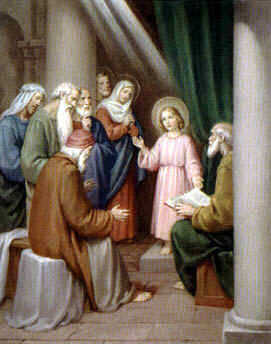
"And it came to pass, that, after three days, [Joseph and Mary] found [Jesus] in the temple, sitting in the midst of the doctors, hearing them, and asking them questions. And all that heard him were astonished at his wisdom and his answers. And seeing him, they wondered. And his mother said to him: Son, why hast thou done so to us? behold thy father and I have sought thee sorrowing. And he said to them: How is it that you sought me? did you not know, that I must be about my father's business? And they understood not the word that he spoke unto them." (Luke 2:46-50)

02 December 2008

Sanctification and Salvation


I often choose topics that are too big to chew but I can't resist. I'm only briefly touching the tip of an iceberg which is gloriously large.

What is the fundamental mission of the Church? The answer is simple: the sanctification and salvation of mankind.

Going therefore, teach ye all nations; baptizing them in the name of the Father, and of the Son, and of the Holy Ghost. Teaching them to observe all things whatsoever I have commanded you: and behold I am with you all days, even to the consummation of the world. (Matt 28:19-20)

We often hear of the great things that the Church has done in the realm of social justice- alleviating poverty, ministering to prisoners, etc- and justifiably so! She has done her task well! And yet we hear nothing about the infinitely more important work which the Church fulfills in leading the Lord's flock to salvation. No other calling is more important. For,

...what doth it profit a man, if he gain the whole world, and suffer the loss of his own soul? Or what exchange shall a man give for his soul? For the Son of man shall come in the glory of his Father with his angels: and then will he render to every man according to his works. (Matt 16:26-27, Mark 8:36*)

What profit do we have to be freed from poverty, to have the comforts of life, to be free from physical bondage, if our souls are still chained down by sin? All is dust but the soul is eternal. If we allow ourselves to replace the spiritual life with the charitable one, virtuous as acts of mercy and charity are, we put ourselve in grave risk of forfeiting our souls! And should we deny the priority of the spiritual life as Catholics over all other things without reservation, we effectively deny eternity and the salvation which is to come. Beware!

We have much to be thankful for and should be greatly inspired by the works of charity fulfilled by the faithful. Indeed, our Lord has commanded us to love our neighbor and to fulfill such works with zeal. And yet, the most important work that we as the faithful can possibly do is pray unceasingly. Pray for the faithfully departed. Pray to the saints that they may intercede on our behalf. Pray for the sanctification and salvation of mankind, for it is only by this that our Lord's Kingdom will come.

Remember the event in the Gospel according to Mark, chapter 2. The paralytic, gravely afflicted in the soul and flesh, is lowered down by four men through the roof before our Lord. In that moment, seeing the man ill from palsy, the Lord says to him, "Son, thy sins are forgiven thee" [italics added]. Witnessing this most grievous of physical maladies, our Lord Jesus Christ takes as priority the healing of this man's soul of its sins. This, likewise, is the mission of the Holy Mother Church.

My beloved priest once said in a sermon, "I only ever pray for one thing. You need only pray for one single thing: the sanctification and salvation of mankind." Should we pray for a lifetime and witness by that prayer the sanctification and salvation of one man, that singular act will be greater in weight than if we were to save 100 men from physical strife, only to see their souls condemned. So much so that we may come before our Lord and hear His glorious words: "Well done, good and faithful servant, because thou hast been faithful over a few things, I will place thee over many things: enter thou into the joy of thy Lord." (Matt 25:21)

21 November 2008

Catholic Word of the Week - Host

host - the unleavened bread destined to receive Eucharistic Consecration; sometimes used to refer to the consecrated species. From the Latin, hostia "sacrifice," also "the animal sacrificed," applied in Church L. to Christ

In the unbloody sacrifice (hostia) of the altar, Christ himself becomes manifest in the host as the Paschal Victim, just as Abraham, our predecessor, offered up a spotless Lamb in place of his son.

What happens at Mass?
Unde et memores Domine, nos servi tui, sed et plebs tua sancta, ejusdem Christi Filii tui Domini nostri tam beatae passionis, nec non et ab inferis resurrectionis, sed et in coelos gloriosae ascensionis: offerimus praeclarae majestati tuae de tuis donis ac datis, hostiam † puram, hostiam † sanctam, hostiam † immaculatam, Panem † sanctum vitae aeternae, et Calicem † salutis perpetuae.

Wherefore, O Lord, we, Thy servants, as also Thy holy people, calling to mind the blessed passion of the same Christ, Thy Son, our Lord, and also His resurrection from the dead and His glorious ascension into heaven, offer to Thy supreme majesty from Thine own gifts bestowed on us, a pure † victim, a holy † victim, and unblemished † victim, the holy bread † of eternal life, and the Chalice † of everlasting salvation.

16 November 2008

"By Grace You Have Been Saved"

I just finished reading an article so impeccably written and succint that I will not do it the injustice of paraphrasing. I will simply place a link here to a fascinating blog which I discovered called "Nicene Truth", written by a Reformed Protestant (Calvinist) convert to Catholicism.

The particular article of interest is called, "By Grace You Have Been Saved", an in-depth discussion on such oft-employed terms as "justification", "grace", "salvation", "faith", and "works". Are we saved by faith alone or by faith and works? What is the role of grace? This article aptly captures the truth of the Catholic teaching on these questions and is deeply enlightening.

Tolle et lege!

15 November 2008

The Armies of Perversion March!

Anyone who thinks Christianity is not a persecuted religion only has to watch this video to see one of the most despicable and scandalous acts that I have ever seen- activist homosexual perverts cursing at an elderly woman, tearing away her Cross, and trampling it underfoot! Where are the police? Where is our government? Is this the mark of a civilized nation where freedom of speech is defended?

The people of California have spoken for the second time. Prior to the California Supreme Court justices telling the voters to take a walk, the voters voted to uphold the traditional definition of marriage as between one man and one woman. Responding to the .01% of the population represented by the sodomite fringe, four treacherous justices ruled that the democratic vote was worth nothing and then gave gays and lesbians the "right" to legally sodomize. Now, the people spoke again and once again the dictatorial homosexual mafia is telling them to drop dead. Where is the goverment to disperse the mobs and restore our democracy? Nowhere!

We're witnessing not just the most essential functional unit of civilized society being torn to shreds but our very faith spit upon by radical hedonists who would stop at nothing to gain the legal right to do whatsoever they please. When will the rule of law be reestablished? When will a high-level political figure stand defiantly in defense of our most sacred beliefs and salvage our crumbling civilization? When?


14 November 2008

Catholic Word of the Week - Heresy

heresy - a species of infidelity in men who, having professed the faith of Christ, corrupt its dogmas; the obstinate post-baptismal denial of some truth which must be believed with divine and catholic faith, or it is likewise an obstinate doubt concerning the same --> heretic, heretical. From the Gk. hairesis "a taking or choosing," from haireisthai "take, seize," middle voice of hairein "to choose," of unknown origin.*

My Presbyterian friend denies the Real Presence of Our Lord in the Eucharist, thereby committing grave heresy.

Catholics who vote for pro-abortion politicians are heretics in that they overtly reject the teaching of the Church on the sanctity of life at all stages.

A person unlearned in the Catechism and Sacred Scripture is easily susceptible to pervasively heretical ideas which so permeate our modern culture.


Heretics are really confused people.

12 November 2008

Besieged

For some strange reason the past several days have been fraught by religious discussions in which I have grown increasingly disillusioned by the errors that are out there. In one case I could sense the presence of the deceiver launching his attacks upon the Church. I have been deeply distressed to say the least.

It began this weekend when I found myself in a two and a half hour long conversation with a Protestant friend talking primarily about Calvinism, which she adheres to in the guise of "reformed theology". Whatever you call it, I was profoundly disturbed by the claims that were put out and made it clear. What a hopeless and concocted theology! It denies the entire loving nature of God and mires otherwise self-evident teachings in a "tulip"-laced morass of erroneous babble! I very effortfully defended our cherished belief in the Eucharist as the source and summit of the Faith, on the mystery of the Incarnation and of the Sacred Tradition which compliments the Scriptures among other things. And yet against the folly of Calvinism what can one do?

In addition to another chat about Calvinism two days ago, today at lunch I was sitting on the front porch of my workplace and overheard two guys "discussing" Catholicism, or their misperception of it, rather. In reality, one person was throwing out facetious, conjectural, and ultimately baseless claims about Catholic teaching and the other simpleton simply replied, "No way! I never knew that!" My blood was boiling and I regret not speaking up as I felt I should have.

Among the insanities uttered was the "Catholic belief" that by walking through the doors of St. Peter's Basilica, we're entering into a heaven-like place and thus are saved. There was the fascinating comment about how Catholics for 2000 years have completely missed the line in Matthew 23:9 saying that we must call no man on earth our father, and yet we call our priests "father", therefore the entire faith is a hoax. There was the profoundly disturbing statement that the Eucharist is just a symbol, that we're insane to derive from the Bible the belief that we can eat Christ himself, that it is ludicrous (at least he acknowledges that it is indeed a difficult teaching). His most erroneous claim was that there is absolutely no biblical basis for the doctrine of the Eucharist, which is absolutely unfounded. The list goes on. I felt like I was being fired at with spiritual cannon fire that was withering.

Now, I was actually taking detailed notes of the conversation because it was perfectly audible from where I was seated, as such I also noted their statements of erroneous Protestant doctrine. The most irksome and oft-repeated statements revolved around that most cherished of errors: the belief in sola scriptura. Here are the choice statements which I overheard:

"The Bible was written by God"
No. It was written by divinely-inspired men from the earliest Hebrews to the early Christians who devoted their lives, however perfectly or imperfectly to seeking God. They and their writing, however much inspired, was clearly affected to some extent by the context in which they lived along with the inspiration received.

"Everything that I believe is in the Bible"
The very belief of sola scriptura is nowhere to be found in Scripture. Thus this statement is false right off the bat. Belief finds its sources not just in written word but primarily from our life experience and that which we learn orally. Most importantly, our belief is also an effort in conformity to the true teachings passed down not just scripturally, but by the Holy Mother Church. That is, much of our belief is in fact extra-scriptural, which in its more refined form is referred to by Catholics as Sacred Tradition. It is exceedingly presumptuous to assert that one believes everything that is in the Bible, because our human flaws prevent us from grasping even so simple a command as "love thy neighbor".

"Keep reading, God will reveal things to you."
Using the logic of the above two quotes, I will contend that God has revealed everything that He has intended in the Bible. This is in accordance with sola scriptura. As such, any further revelation can not be possible, even that which may be stirred in us as we read Scripture. For God to continue revealing things in a extra-scriptural way must prove the existence of a sacred tradition rooted in and emanating from written and unwritten revelation.

What a vexatious past few days these have been. Lord have mercy. Pray for the conversion of those gone astray and for the unity of Christ's Church on earth.

09 November 2008

Our Divine Mandate

As of late I have been asking myself the same question quite frequently: why is it so difficult for us to speak absolutely about our faith? We fall so easily into the trap of relativism because we live in its framework, we are educated to think in a relativistic way, and we are expected to accept multiple options, multiple lower-case t truths, etc. Even if we utter in word what we aspire to believe as absolutely true, often our actions and our subsequent words do not back up this seemingly impossible stance. And yet…

The more I contemplate, the more I am truly convinced that Christianity- read, Catholicism, the only full and true faith revealed to the Church- is the one and only religion with a truly divine mandate, a heavenly bond, a direct call from on High. Both logic and faith confirm this.

No other religion so encapsulates both the fullest reality of our being and the deepest aspiration of every human soul. That we are born deeply flawed and yet yearn every waking day for something better, for a taste of the divine. That to be righteous and to obey the moral law set down by our Creator is perhaps the most difficult thing we can do, bringing with it frustration, vacillation, and persecution, and yet what bliss to follow the narrow path! No clearer sign is there than this: “Blessed shall you be when men shall hate you, and when they shall separate you, and shall reproach you, and cast out your name as evil, for the Son of man's sake.”

What of the other major faiths? For the Jews, at the time of reckoning, when the Son of Man descended in the deepest humility and was then hung on the Cross for our iniquities, they rejected him, preferring to retain their worldly laws and loyalties to cling to a hope which, unbeknownst to them, had just been fulfilled. Muhammed, the Prophet of Islam, led wars and insurrections and ultimately died in peace like many a worldly king. The Buddhists promise personal nirvana through individual contemplation, and yet quo vadis for the rest? And so forth. And yet, the one true God is worshipped and adored through His Son, who alone gave himself up in the lowest humiliation, in the purest act of sacrifice, through his terrible death on the Cross and his subsequent Resurrection. Just as the soldier is the only person who has truly fought for our freedoms, so too our Lord, Jesus Christ, is the only one who has truly died for our sins.

He died in fulfillment of the Greatest Commandment: “that you love one another, as I have loved you. Greater love than this no man hath, that a man lay down his life for his friends” (John 15:13, italics added). With what reluctance does humanity obey this call, with what vacillation! How difficult it is to fulfill, and yet how simple it is to fall to selfishness, self-fulfillment, impatience, and the like. Verily, this is a divine call, for such a mandate could not possibly have its origin in the selfish heart of man.

This was and is the revolution ushered forth by the Incarnation, Death, and Resurrection of our beloved Lord Jesus Christ, that not by condemnation, nor isolation, nor hatred are we to live and serve our Lord, but by the heavenly grace that is love, the unconditional yearning for the good of another. And to this end we are to dedicate all in our being to seeing that our brethren be sanctified unto their ultimate salvation in the oneness of the Spirit, through the mercy of our Lord and King, from now unto the end of the world. Amen.

07 November 2008

Catholic Word of the Week - Erroneous

In order to arm ourselves with the vocabulary needed to fight heresy, I am going to begin posting choice lexicon from time to time with a contextual usage. Go forth into battle with edifying lingo! Enjoy!

erroneous - not true, correct, or right; containing error or errors. From the Latin, errare, to wander

The young man's erroneous perception of Catholic teaching led him to vote for a blatantly pro-choice candidate. Because of his error, he taught these false ideas to even more feeble-minded faithful, thus cementing his errancy. The most effective way for him to rectify his erroneous beliefs would be a committed study of the Catechism and pertinent Scripture passages.

The celebrant of this "Mass" has extremely erroneous ideas of what the liturgy should look like.

03 November 2008

2008 Presidential Election: Time for Foreboding

The Lord be praised- our long national squabble will be over within hours. What is the American obsession with such a painfully long election cycle? It is often heard that our elections last months on end because we are choosing the holder of the most powerful office in the world. Or maybe it is a period in which we engage in national soul-searching?

If in the end I were to learn nothing in this election save one tidbit of wisdom, it would be this: mankind is, without the slightest doubt, broken and corrupted to the core by sin. And yet, it is because of the sting of sin that we can experience God's purest love and obtain that courage by which we make His will be done. No one is free from this sting, no less in this most pivotal election.

I have seen the most despotic and dictatorial elements of our increasingly impatient, desperate, and reactionary society work with all of their strength to crush the voice of the minority, to silence the teachings of the Church, and to muzzle and ridicule those who disagree. While both sides of the political spectrum are guilt of this, no side is more to blame than the Left.

Dare to love your country, and you are called a backwards patriot.
Dare to love your God, and you are a zealot, a fool, an unintelligent oaf.
Dare to love your family, and you are just an old-fashioned relic of an oppressive past fading away.
Dare to stand up for the innocent, the unborn, and you are cursed, your efforts mocked, your signs and literature torn down and stolen, your name smeared!
Dare to stand up for your traditions and beliefs, and you are dismissed as an uneducated conservative.
Dare to work for your living, to be independent, to try to make your way in the world, and you are selfish!

We're living in a dictatorship! We don't need to wait for the next president to be chosen! Our beautiful country is being murdered by radical elements who hate it! Mark my words: the days are on the horizon where criticizing another element of society or the government will bring fines or other punishment. Where you will be forced to fund abortions, euthanasia, and social programs that encourage slavery through dependence with your tax dollars. Achievement will be frowned upon and even discouraged. Religion and traditional symbols of our Christian roots will be removed from public spaces with a degree of radicalism unmatched even by the Europeans. Independent thinking will be branded as bigotry, discrimination, backwardness, and ignorance and will be swiftly repressed by the brainwashed elements. Defending your nation and its sovereignty from incursions and enemies will be seen as isolationist and insular, vestiges of a primitive, medieval closedness. Private and church charities will be taxed or regulated to the point that the poor will have nowhere to turn but the government, which they will be forced support for their livelihood and will therefore never dare to question.

The list goes on and on! If we do not wake up and speak out against the despots and dictators in our midst, then there is no greater proof that these things will happen than the fact that have happened and are happening as we speak. We have seen this in our very own country, our neighborhoods, abroad, and right here in this town where I live!

"They who can give up essential liberty to obtain a little temporary safety, deserve neither liberty nor safety." - Benjamin Franklin

02 November 2008

An intriguing thought experiment...

I entered into a cognitive reverie yesterday and the most delightfully revealing thought experiment entered into my head. It has to do with drawing moral lines. By using the liberal arguments for amorality against a hypothetical proponent of gay "marriage", our proponent ends up hitting a wall.

So here's the thought experiment: a pro-gay "marriage" lad, who happens to be called Bob in my reverie, is taking a walk through a park where he runs into a most intriguing personage named Fred. Their discourse went as follows:

BOB: Hey, Fred!
FRED: Hey Bob, what's up?
BOB: Not much. Hey, are you voting for that gay marriage amendment on Election Day, you know, the one defining marriage as between both heterosexual and homosexual couples? It will finally let people who love each other get 'married' and give them the 'rights' they've so longed for!
FRED: Heck yea, man. Freedom from bigotry. True equality! But I don't think the amendment goes far enough. What if, like, a buncha' people love each other? Like, a buncha' dudes? Why shouldn't they get married? That's not fair.
BOB: Oh, well...Yeah. I guess so. Yeah, maybe they should be allowed to.
FRED: Yeah. You know what used to be 'in' and should come back? That thing where one guy has a bunch of wives. Yeah, polygamy!
BOB: Uh, well... That's a little weird.
FRED: Why's that weird? If they love each other, why not? I mean, why should only gays get to marry? Are you saying polygamists don't have rights? Are you imposing your morality on me?
BOB: Well no, dude. That's just a little weird, don't you think? I mean, gays should get rights but the polygamy thing is weird.
FRED: Why's it so weird? One man, many women! Why limit people? We're a nation of liberty! Stop pushing your morals on me, dude! I mean, if I love my mom that much, well, dude, why not?
BOB: You're joking, right? You're talking about in-...
FRED: Yeah man! Nothing is greater than love! We should be more open and inclusive, and less divisive. Why should your definition of love be pushed on me?
BOB: Well...No...It shouldn't. But, that's disgusting.
FRED: If I think it's ok, it's ok! Don't tell me it's disgusting you bigot! It's just different!

As we can see, the Pandora's box that Bob initially opened ultimately swallows him whole, as he finds himself in a moral no-man's-land where he can't say why incest is taboo and polygamy is disgusting, etc. He finds that his initial moral judgment has opened a can of worms and that it comes back to haunt him. He learns that his moral judgment is arbitrary and that he can consequently make no real moral judgments.

It seems that the only moral judgment that is not arbitrary with regard to marriage is that most natural one: that marriage is between one man and one woman in a union of love which alone is capable of bearing new life.

Case closed!

29 October 2008

The Perverted Eternal Perspective

Lately a great many things have been profoundly disturbing me. Granted, I live in a perpetual state of being disturbed by much that I see around me in the world, and yet, by the grace of God, I have much hope that such lunacy will not persist forever.

Perhaps the most troubling thing that I have heard recently came from reading a message written by someone who I don't even know, but who I do know is a "pro-life but pro-Obama 'Catholic'". Now, the expression "pro-life, pro-Obama, Catholic" is a rare case of a triple oxymoron, where it just doesn't make sense. It's about as sickening as a so-called "pro-choice Christian". Anyways, with regard to the preborn, our "pro-choice Catholic" began with the usual qualifier "while I am personally pro-life..." and then continued by saying: considering that the murdered preborn will go straight ahead to heaven and be with God anyways, we should focus our resources on alleviating the suffering of the post-born since, from an eternal perspective, this does the most good. It's a frighteningly twisted pragmatic argument that has a most perverted moral basis. It completely skirts every possible logical argument and defies all reason.

Why? Point-blank, you murder the baby to satisfy an end that is not remotely "eternal" but entirely mundane and sinister. It is inherently secular. Where does the word "secular" come from? It comes from the Latin word, saecula, "age" or "epoch", such that secularization means the elimination of the "eternal perspective" in favor of a now-obsessive preoccupation with the here and now. "Having this baby will ruin my career which I am planning for now." "I am not ready to have this baby now". The laundry list of excuses goes on. So, our "pro-choice Catholic" essentially negates her own belief system to begin with. More gravely, still, the logic can be applied in many troubling cases that we are already witnessing.

"We should put the old man out of his misery [through euthanasia] so he'll be with God now".
"I don't have the financial resources right now for this baby so leave it out to die [through infanticide] once it is born. Fortunately, he'll be with God."

This is a diabolical sugar-coating of the worst sort. The fact of the matter is that it is indeed virtuous to work for the alleviation of the living through works of mercy and charity. However, to sap the life of those who we believe may lead a difficult life, or who are leading difficult and/or pained lives, is the ultimate denial of hope, the most blatant expression of a eugenic desire to purify the world of all plight, and the most despicable perversion of Christian charity that I can think of.

"And the word of the Lord came to me, saying:
Before I formed thee in the bowels of thy mother, I knew thee: and before thou camest forth out of the womb, I sanctified thee, and made thee a prophet unto the nations.
And I said: Ah, ah, ah, Lord God: behold, I cannot speak, for I am a child.
And the Lord said to me: Say not: I am a child: for thou shalt go to all that I shall send thee: and whatsoever I shall command thee, thou shalt speak.
Be not afraid at their presence: for I am with thee to deliver thee, saith the Lord.
And the Lord put forth his hand, and touched my mouth: and the Lord said to me: Behold I have given my words in thy mouth:
Lo, I have set thee this day over the nations, and over kingdoms, to root up, and to pull down, and to waste, and to destroy, and to build, and to plant. (Jeremiah 1:4-10)
Your comments are greatly appreciated!